Getting around New Zealand with your dog
Utes, ferries, planes, buses, and the days the dog cannot come. This is the logistics side of a New Zealand dog trip, operator by operator, with the bits nobody publishes marked as unknown rather than guessed.
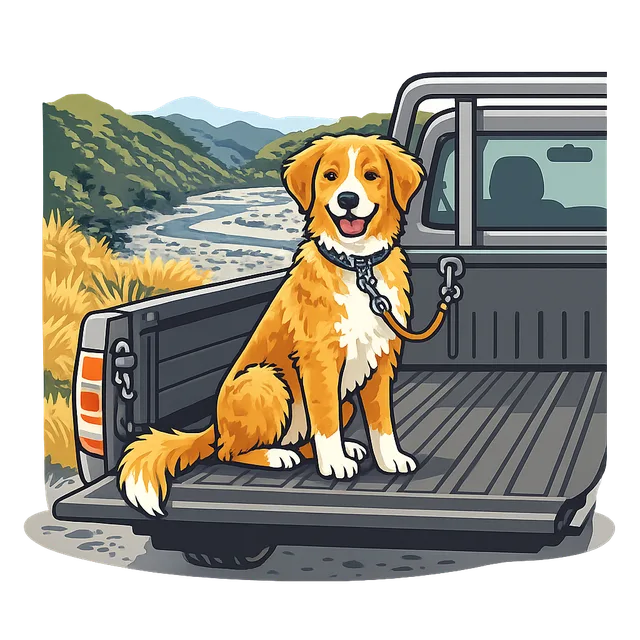
Cars, utes and hot days
New Zealand has one hard rule about carrying a dog, and it is not in the road code, which is why nobody can find it. Under regulation 15 of the Animal Welfare (Care and Procedures) Regulations 2018, a dog carried on the open deck or open trailer of a moving motor vehicle on a public road must be secured so it cannot fall off or hang off, for example by tether or cage. If it is tethered, the tether must by law be short enough to stop the dog's legs reaching over the sides, and long enough to let it stand or lie down in a natural position. It is an infringement offence carrying a $300 fee, and on conviction a fine of up to $900. The duty sits on the dog's owner and on every person in charge of the dog, and for an infringement notice an inspector can treat the vehicle's owner as the person who committed it.
The working exception is real and worth stating plainly: a farm dog does not have to be secured on an open deck while it is actually driving or managing stock, including shifting stock down the road between paddocks. Mopeds, motorcycles and quad bikes sit outside the rule.
MPI's transport code of welfare adds the practical detail on top: anchored close against the cab, and a swivel between the anchor point and the collar.
It gets enforced. In September 2023 an unrestrained American bulldog fell from an open deck on Main North Road at Belfast, Christchurch, at about 60 km/h and fractured its patella. SPCA prosecuted the driver, who pleaded guilty. The maximum penalty is a $900 fine; the judge instead ordered him to pay SPCA $1,941.59 in reparation for the vet bill.
Inside the cab the picture is thinner. We could not find a New Zealand regulation covering restraint inside a vehicle cabin, so the open-deck rule appears to be the only specific one. SPCA's position is that animals should be securely, comfortably and appropriately restrained, and that there is currently no industry oversight of restraint products sold here: harnesses, crates and carriers carry safety claims without independent crash testing. Treat a clip-on harness as something that keeps the dog out of your lap, not a proven crash restraint.
Hiring a campervan
Two big hire operators publish dog terms, which is more than most do.
- Britz takes pets in every campervan model, up to two registered dogs or cats, on a flat pet fee of $325 per hire for 1 April 2026 to 31 March 2027, rising to $335 the following year. It is added at booking, not paid on arrival, and it covers a deep clean for the next guest. Conditions: treated for fleas beforehand, toilet trained, clean and dry before they get in, supervised on a lead at pickup and dropoff, never left alone in the camper, and you supply the driving restraint. Damage and soiling are the hirer's cost and sit outside any liability reduction product. See Britz travelling with pets.
- JUCY takes dogs in campervans and motorhomes only, not in its rental cars, maximum two, restrained in the rear while moving, clean and dry before entry, never left alone, with the fee added at booking. See JUCY dogs in campers.
Other operators are widely reported as pet-friendly. We have not read their own terms, so we are not listing them: ring, and get it in writing. Britz is blunt enough to warn hirers that many national parks prohibit pets and to check DOC first, which is a hire company telling you the trip you booked may not work. Take the hint: read where dogs cannot go before you pick the route.
Where you park at night
It runs on two rulebooks, and people conflate them constantly. The camping question (is this a permitted spot, is the vehicle certified self-contained) is decided by one authority. The dog question (is this land open to dogs at all) is decided by another, and they disagree often, because council camping areas frequently sit on reserves with their own dog bylaws and DOC campsites can need a dog permit on top. Check dog access first, then camping legality, then book. We keep to the dog layer: for the camping layer, go to the council and the current self-contained vehicle rules.
Two DOC conditions shape the packing list. Dogs may go to huts, lodges, cottages and cabins in areas that allow dogs but must not go inside them, and you are responsible for the dog's shelter and for securing it outside. Sometimes there is a kennel beside the hut. Often there is not. Campsite conditions also include no excessive noise after 10pm: if the dog does not comply you can be asked to leave, and DOC says you will probably not get a refund or your deposit back. See camping with dogs and overnight and huts.
Cook Strait: the two operators are not the same
Neither operator markets the difference that matters most. Bluebridge states that its vehicle decks are locked during the sailing, so if your dog is in your vehicle or in a kennel you cannot visit until the ship docks. Interislander says that once underway there may be times you can visit your pet, just ask the crew, and that a crew check may happen as well: possible, not guaranteed, and subject to sea conditions and the captain. That difference decides whether a problem at sea is fixable.
- Bluebridge: vehicle-deck kennels are $15 one way, pre-booked, and foot passengers with a pet must use one. The dog-friendly cabins are on the Connemara on select sailings, from $89 two-berth and $109 four-berth, maximum two dogs, with a communal outdoor dog area on deck 6 for those bookings. Dogs use the stairs, not the escalators, and cats are not allowed in dog cabins. Tie this to the vessel, not the brand: no Connemara, no cabins.
- Interislander: pets can stay in your vehicle at no extra charge, no more than two medium dogs in a car, ute or SUV and no more than three in a campervan or caravan, with all openable windows lowered at least 7 cm. Kennels take one large dog (standing back height 60 cm) or two dogs under 60 cm, and measure roughly 800 x 800 x 600 mm. Foot passengers must pre-book one and they fill up over summer. More than three dogs inside a vehicle needs an exemption applied for in advance at [email protected], with sailing details, animal numbers, method of transport and photos of the carrier.
One Interislander rule catches out half the utes in the country: dogs must be inside the vehicle, not on the back deck, so a tray dog moves into the cab before boarding. Either way, book the dog when you book the sailing, not after.
Heat on the vehicle deck
Both terminals have somewhere to empty the dog first. Interislander names Auckland Street Skate Park and Dog Exercise Area, 111 Auckland Street, Picton, and Cashmere Park Dog Exercise Area, opposite 19 Onslow Road, Khandallah, Wellington, which is a short detour on the way in. Neither is described as off-lead by the operator, so check the council rule or our map before you unclip.
Flying with a dog
Air New Zealand carries dogs domestically in the pressurised, climate-controlled hold, not the cabin, as checked baggage in an approved carrier. A flat fee of $120 applies, paid at the airport, and the carrier counts against your baggage allowance. It is not a tick box: book the flight, then submit a form with pet details, carrier dimensions and weight to have the animal added.
- The crate: IATA Live Animals Regulations. Fibreglass, metal, rigid plastic, welded metal mesh, solid wood or plywood. Entirely mesh carriers and pop-up soft carriers are not accepted. Cable ties on all four corners of the door. Ventilation on the upper halves of three sides, not the door.
- The ceilings: 60 kg for pet and carrier combined, and a maximum carrier of 85 cm high by 66 cm wide by 115 cm long on turboprops. Heavier animals go on the A320 and A321 jets through an approved cargo transporter, because Air New Zealand Cargo does not take animal bookings direct from the public.
- The airport trap: check in 60 minutes before departure, and at Auckland, Wellington, Christchurch, Nelson and Queenstown the dog must already be crated before you enter the terminal. Regional airports let you walk it in on a lead.
Air New Zealand's public pet page lists no snub-nosed breed restriction and no summer heat embargo, unlike several Australian carriers. That is an absence we observed, not a policy we confirmed, so ring and ask if you are flying a brachycephalic dog, or flying in February.
The two small carriers
Sounds Air and Barrier Air cover dogs and routes the national carrier does not, on aircraft where space is the binding constraint.
- Sounds Air takes small pets on its Pilatus PC-12 and Cessna Caravan aircraft: carrier ceiling 50 x 35 x 35 cm because space is very limited, $40 service fee per animal, cage weight counting toward the 20 kg allowance with excess at $3 per kg, no soft carriers. Phone bookings on 0800 505 005, subject to space.
- Barrier Air runs tighter still: exactly one pet per aircraft, phone bookings on 0800 900 600, IATA crate required with hire crates at $60 one way, fares of $85 up to 20 kg and $95 at 21 kg or more, one destination with no connections, carriage at the owner's risk, and animals crated across the entire Auckland Airport precinct. Dogs must be clean, healthy and clear of fleas and ticks, and it asks you not to fly within 24 hours of surgery or sedation.
Buses, trains and city ferries
The three biggest cities landed on three different answers to the only question that matters, which is how big your dog is. All three share the same off-peak window: 9am to 3pm and after 6.30pm on weekdays, and all day at weekends and on public holidays.
- Auckland (AT): any size dog travels at no extra fare. "Small ones in an approved carrier, bigger ones in a cage-type muzzle and a lead on buses and trains. Ferries are set operator by operator: AT says no muzzle is needed on a ferry, Fullers and Belaire routes want a carrier if you go inside the cabin, and SeaLink's Pine Harbour service is back deck only." Permanent since the 2023 trial. Service and assistance dogs travel at any time and never need a muzzle. One pet per person, no upper deck, no school buses, under-16s need an adult with them, you may not get on a crowded bus, and you may be asked to move if an assistance dog boards.
- Wellington (Metlink): carrier only. The animal must be fully enclosed in a suitable pet carrier, in Metlink's words "not just a bag or backpack", on your lap or in luggage space. There is no large-dog option at all. Trains, buses and harbour ferries are covered, except sailings to Matiu/Somes Island, which is a wildlife sanctuary. Pets cannot occupy priority seating, and a disruptive animal can be asked off at the next stop.
- Christchurch (Metro): small pets only. A carrier no bigger than 58.4 x 38.7 x 33 cm, on your lap or under the seat in front, or a small dog on a lead wearing a basket muzzle. Large dogs are not permitted on Metro services. One carrier or one dog per customer aged 16 or over, no school buses, no upper decks, no additional fare, and the pet does not get a seat.
Metro's policy also covers the Diamond Harbour ferry, where leashed dogs must stay outside at the rear of the vessel. "It is the only scheduled South Island passenger ferry we know of where the dog rides with you rather than in a vehicle or a kennel, with the honest catch that the small-pet size limit applies there too, so most tramping dogs are out."
Outside those three networks we have not confirmed the rules, and we would rather say so than guess. Ring the regional operator, and tell us what they said so we can add it.
Islands: getting to the Gulf
The Hauraki Gulf is two operators with two models. SeaLink carries dogs at no extra charge on the outside decks, on a lead and under control, with only registered guide and assistance dogs inside the passenger lounge, plus a small seating area near the café on the vehicle deck on Great Barrier sailings. The catch nobody warns you about: on sailings carrying dangerous goods all passengers must be in the lounge or on the upper decks, so you cannot stay in your vehicle with your dog, and SeaLink's own fix is to book a different sailing. Fullers360 allows dogs on most routes but wants a secure, clean, well-ventilated carrier with a leakproof base inside cabins, a short leash at all times, and no dogs on seats or tables. No dogs go to Rangitoto except trained disability assist dogs. "On the Auckland harbour routes, Auckland Transport's own ferry terms say dogs travel at no extra charge with a fare-paying passenger, with allocated seating on the outside decks. For anything outside those routes, ask when you book."
Getting there is the easy half. Much of Aotea (Great Barrier) is conservation land where dogs are not allowed, so check the exact place on our map or with DOC before you commit to a sailing. Gulf operators also ask every passenger to arrive with gear carrying no pests, dirt or soil, because most of these islands have been cleared of predators and now hold tuatara, takahē, shore plover and kiwi. That lands squarely on dog gear: a crate, bed, towel, toy bag and food sack are ideal habitat, rats get through a 12 mm gap and mice through 7 mm, stored gear is flagged as high risk, and soil in paw fur and boot treads carries kauri dieback. Pack dog food in sealed lidded containers. Barrier Air's Hauraki Gulf biosecurity briefing says a trip may not go ahead without passenger co-operation.
Rakiura, honestly
Stewart Island gets asked about a lot, so here is the straight answer. No visitor dog ban exists, but Rakiura National Park covers most of the island and dogs are prohibited in national parks, the Rakiura Track has no dog access, and DOC's dogs-on-boats rule means you cannot take a dog ashore or be within the foreshore of conservation land that does not allow dogs. A dog on Rakiura is an Oban dog, and not much else. Kiwi there have been killed by dogs out of control, the Stewart Island Rakiura Community Board has asked for compulsory kiwi avoidance training for island-based dogs and encouraged it for visiting dogs, and Southland District Council reviewed its dog control policy and bylaw in 2025, so read the current version before you travel. Neither Stewart Island Flights nor the RealNZ ferry publishes a pet policy we could retrieve, so carriage is a phone call, not a booking.
The no-dog day
Every dog road trip here hits the same wall: you have driven to a park gateway and the park is shut to dogs. Fiordland is the sharpest version. DOC states that unless by special permit, dogs are not allowed in Fiordland National Park, including Milford Sound, and that there are currently no campsites in Fiordland where you can take your dog. What does exist: Mavora Lakes Park and the public conservation land between the Te Anau to Manapouri road and the Waiau River need no permit, while Takitimu, Snowdon Forest, Ewe Burn, Supply Bay and Welcome Point to Camp Bay need one from the Fiordland National Park Visitor Centre, 1 Lakefront Drive, Te Anau (+64 3 249 7924).
The answer for the rest of it is day boarding. Te Anau, Franz Josef, Aoraki/Mount Cook Village, Tūrangi and Taupō all sit within reach of kennels or sitters, while Queenstown and Wānaka run mostly on home boarding and small operators rather than large facilities. We do not rank or vet kennels and we take no referral from any of them: ring, ask what a day costs, and ask what they need from you.
The other half of the answer is planning so the dog is not the problem. Pair a park day with a nearby walk the dog can do, or a town day, and split the group. Our regional pages and trip ideas are built around exactly that: what is open to dogs within driving distance of the thing that is not.
Before you go: the paperwork critical path
Almost none of this can be sorted at the trailhead, and almost all of it is invisible until it is too late. Work backwards from your departure date.
- Ten or more days out. If a kennel cough vaccination has lapsed and the dog is boarding at any point, it needs updating at least ten days before the stay.
- A week out. DOC dog permits take up to five days to process and come from the DOC office or visitor centre closest to the place you are going, not a national desk. 28 of the 77 dog-welcoming campsites we map need one, and 45 are lead-only. Start at our permit guide, which drafts the email for you.
- A week out, separately. The Queen Charlotte Track allows dogs on a leash between Anakiwa and Davies Bay only, on a permit from the Nelson Visitor Centre (03 546 9339). Dogs are not permitted anywhere else on it or on any side track off it, and the private-land sections need a separate Queen Charlotte Track Land Cooperative pass. No Picton water taxi we checked publishes a pet policy, so carriage is a phone call, and DOC's dogs-on-boats rule still applies where you land.
- At booking, not later. Campervan pet fees are added at the time of booking. Ferry kennels must be pre-booked, Interislander says they fill up especially over summer, and a foot passenger with a dog cannot travel without one. An Interislander exemption to carry more than three dogs inside a vehicle has to be applied for well in advance, with photos of the carrier.
- After booking a flight. Air New Zealand pets are a form, not a checkbox. Barrier Air takes one pet per aircraft and Sounds Air is subject to space, both by phone only, so sort them before you book anything non-refundable around them.
- In the glovebox. Council registration current, microchip details up to date, a dated vaccination record, your vet's number and the after-hours clinic nearest your route, and a lead even for places that do not require one.
Then the part that is actually the point: check every stop on the route is open to dogs before you leave, not when you arrive. Start with the map, then where dogs cannot go. If a place page says nothing about dogs, treat it as unknown and ring the managing office, because absence of a rule is not permission. How we reach each verdict is in how we check.