Dogs of Aotearoa: kurī, huntaways and New Zealand dog culture
Dogs have been walking this country for about 700 years, and most of what New Zealand quietly expects of a dog owner comes from that history rather than from a bylaw. Here is the short version, with the sources it came from.
Kurī: the first dogs on these tracks
Dogs have been walking this landscape for roughly 700 years. Kurī, the Polynesian dogs, came ashore with the ancestors of Māori on the migration canoes from East Polynesia, and Te Ara dates their arrival to the 13th century. They were small and short-legged with bushy tails, around 13 to 15 kg, coats running from yellowish brown through black, white and spotted, and they howled rather than barked. They hunted, they were eaten, and their skins made kahu kurī.
Kahu kurī are cloaks: strips of dog skin with the hair still attached, sorted by colour and sewn with fine bone needles onto a muka (flax fibre) kaupapa. Te Papa puts their standing plainly: "The possession of a kahu kurī immediately identified the owner as a rangatira." Each cloak carried its own name and history, and passed between people of rank on ceremonial occasions.
These were not anonymous animals. By the 18th century individual kurī had names and whakapapa, and some were given formal burials. Patricia Pillay's study of teeth from more than 100 kurī found that most North Island animals had no cavities or plaque, pointing to low-sugar diets, relatively soft food and little sign of malnutrition. Kurī did not survive interbreeding with European dogs and were gone as a distinct population by the 1860s. The remains of the last known pair, a female and her pup, are held at Te Papa.
Irawaru is the guardian deity of kurī. In the account recorded by Te Ara, Irawaru was the brother-in-law of the demigod Māui; angered at his laziness, Māui waited until Irawaru was snoring and pulled his ears, nose and spine into the form of a dog. Tellings differ. The Te Aka Māori Dictionary glosses Irawaru as a man "turned into the first dog by Māui-tikitiki-a-Taranga", while other accounts give Māui's motive as jealousy over Irawaru's success at fishing.
Rāhui, wāhi tapu and marae
A rāhui is not a council rule and not a DOC alert. Te Kotahitanga o Ngāti Tūwharetoa describes it as "an indigenous, Māori principle used to regulate human activity for the future well-being of the people and natural resources"; the word means "to prohibit, or a prohibition". There are two broad kinds: a conservation rāhui to let the mauri of a place recover, and a rāhui following a death, often a drowning, to let tapu lift. Rāhui are decided by hapū and put in place through rangatira, and as Ngāti Tūwharetoa states, "no government institution or political party can initiate a rāhui". You do not honour one because someone can fine you. You honour it because you were asked.
You will usually find out from a sign or a pou rāhui at the trailhead, from an iwi or rūnanga announcement, from a council notice, from DOC's alerts pages, or from local news. Te Kawerau ā Maki describe the Waitākere rāhui as "a customary prohibition ... to prevent and control human access", for protection that is "both physical and spiritual".
The same care applies to wāhi tapu and urupā. DOC notes that many places on public conservation land are wāhi tapu, with tikanga that can include not eating, running or making loud noise, which is a poor fit for a loose dog. Heritage New Zealand's List / Rārangi Kōrero is the official national record, searchable on a map, but plenty of wāhi tapu are deliberately not listed, so the List is a floor and not a ceiling. We do not map them either. On marae, kawa is set locally: you wait to be invited on, and your dog is not part of that invitation unless someone tells you it is. Ask, and take the answer.
The dog this country made
The huntaway was bred in the late 19th century for high country nobody could work quietly. Big, loud, tireless, selected for a deep bark rather than a yap, usually black and tan, 25 to 40 kg. Dogs New Zealand lists it as breed 535 in the Working Group and says it was "selected solely for its ability to tirelessly work stock day in and day out". Worth remembering at a hut: a bark bred to carry across a gully carries across a bunkroom too. The heading dog is the other half of the pair, quiet, all eye, gathering rather than pushing.
The paper trail runs back further than the recognition. A sheepdog trial advertisement from the Upper Waitaki in 1870, "huntaway sheepdogs" wanted in the Otago Daily Times on 25 August 1884, "heading and huntaway collies for sale" in the Evening Post on 7 October 1885. The New Zealand Kennel Club only recognised the breed in August 2013, the first of New Zealand origin ever recognised, and as at 2016 it was the second most registered breed here. Dogs NZ still publishes the trial association's view on the same page: "a Huntaway should never be shown, due to the large variance in colour, type and size". A dog defined by the job, not the look.
You can watch that job done properly. The NZ Sheep Dog Trial Association covers 157 clubs in 13 centres. There are four standard classes: long head and short head and yard for heading dogs, zigzag hunt and straight hunt for huntaways, with eight to fourteen minutes allowed depending on the class. A&P shows are the easy way in. Leave your own dog at home: trial grounds hold live stock and working dogs, and visiting dogs are not welcome unless the club says otherwise. Ring the centre secretary first.
The monuments road trip
Three dogs in bronze, all of them roadside stops on routes you are probably already driving.
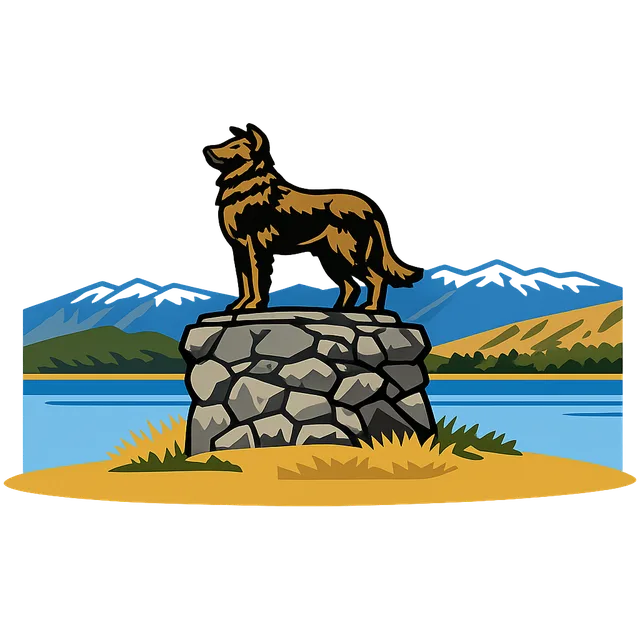
- The Mackenzie sheepdog, Lake Tekapo. Sculpted by Innes Elliott of Kaikōura, modelled on a neighbour's dog called Haig, with the plaster cast sent to London in 1966 for casting. Elliott said the sculpting took about fifteen months. It was commissioned by Mackenzie Country residents in recognition of what the sheepdog did for their livelihoods, and it sits looking out over the lake beside the Church of the Good Shepherd, quietly one of the most photographed objects in the South Island by people who have no idea what it is.
- The Hunterville huntaway, Rangitīkei. A working dog on a plinth in a small farming town on State Highway 1, in the district that built its festival around the breed. Ten minutes, a coffee, a leg stretch.
- Paddy the Wanderer, Queen's Wharf, Wellington. An Airedale who lost his young owner in the 1920s and took up residence on the waterfront instead. The Harbour Board made him Assistant Night Watchman, guarding against "pirates, smugglers and rodents", and cabbies, watersiders and seamen took turns paying his licence. He stowed away on coastal steamers, crossed the Tasman more than once, and went up in a Gypsy Moth. He died on 17 July 1939 and was taken to his funeral by a parade of twelve taxicabs with a traffic officer leading. NZHistory records that a drinking fountain near the Queen\'s Wharf gates commemorates him. The monument, erected in 1945, is a bronze likeness with a fountain and dog bowls below, and is reported to incorporate stones from London\'s Waterloo Bridge. Accounts differ on who his first owner was, so we have left the name out.
All three are short stops with parking, and all three make sense strung together over a long weekend. If you want to build the drive around walks, start from trips or your region.
Hydatids: the campaign this country won
If a farmer's first question about your dog is a worming question, this is why. Hydatid disease is caused by the larval stage of the dog tapeworm Echinococcus granulosus, cycling between dogs and grazing animals, and in people it forms cysts that could and did kill. New Zealand went after it from the late 1950s with an unglamorous machine: local committees, hydatids control officers employed by local authorities, and dosing strips where, in the later years of the campaign, every dog in the country, farm dog and town pet alike, was brought in to be dosed and checked. According to the government's own account of the campaign, hospitalisations peaked at 103 cases in 1953 and were down to seven notified cases by 2001, 1999 was the first year no hydatids were found at slaughter in New Zealand-born animals, and in 2002, after 45 years of work, the country was declared provisionally clear. Provisionally is the operative word, and the declaration came with a warning attached.
What survives is the habit, and one live descendant: sheep measles (Taenia ovis). It is a meat-quality problem for the farmer, not a human health risk, and visiting pet dogs are commonly the source. Ovis Management sets the rule that everyone gets wrong.
More on stock, farmland and what else is out there in poison and hazards.
Finding your pack
If you are looking for a dog to walk with, start by ignoring the breed label. SPCA New Zealand says "the vast majority of dogs entering SPCA care are mixed breeds", and, more usefully, that "visual assessment of mixed breed dogs is highly inaccurate, even when conducted by experts such as shelter workers, veterinarians and dog control officers". That takes the entire best-breed-for-the-outdoors genre off the table. SPCA itself works from behavioural history, notes from staff and foster carers, daily behavioural scoring and standardised assessments, which is a much better model for the questions that actually predict a good day out: recall when something interesting moves, interest in stock and birds, how the dog recovers after a long one, whether it can settle tied up or crated at a hut, tolerance of noise, tolerance of heat. Working crosses are common in rescue precisely because they were bred to work all day, which is both the warning and the opportunity. Buying from a registered breeder is a fine answer too; the point is to ask about the dog in front of you.
Then there is the community, which is bigger and more welcoming than most people realise. Dogs New Zealand's club directory lists breed, obedience, agility, working trials and gundog clubs across 16 regions with real phone numbers and email addresses. The sheep dog trial network is a completely separate rural structure of 157 clubs. Kiwi Avoidance Training, jointly coordinated by Save the Kiwi and DOC, lists trainers you can book by region, and conservation trusts such as The Forest Bridge Trust run training days as community events. Most of the day-to-day track knowledge lives in regional dog groups on social media; those are run by volunteers, so read the rules before you post.
When you are ready to go: 367 walks where dogs can be off the lead, 1,915 walks in total across 15 regions, and the ones to avoid in where dogs cannot go.