Where dogs cannot go in New Zealand
Some places in New Zealand are closed to dogs, and those closures are statute rather than suggestion. Here is what the closed list is made of, the reasoning behind it, and the considerably longer list of places where your dog is welcome.
The places that are closed
The hard line first. Dogs are prohibited in every national park under the National Parks Act 1980 s 56A, and that means all thirteen of them: Tongariro, Te Papa-Kura-o-Taranaki (formerly Egmont), Whanganui, Abel Tasman, Kahurangi, Nelson Lakes, Arthur's Pass, Paparoa, Westland Tai Poutini, Aoraki/Mount Cook, Mount Aspiring, Fiordland and Rakiura. Land held for national park purposes is closed on the same terms. The ban covers the whole park, not only the huts and the famous tracks: road ends, car parks, picnic areas and the twenty minute loop you were going to knock off before lunch are all inside the boundary.
It is a statute rather than a local call, so nobody on the ground can wave it through. The offence sits at s 56I and carries up to 12 months imprisonment or a fine of up to $10,000 on conviction. Outside the parks the matching offence is Conservation Act 1987 s 26ZZP, which carries the same penalty where DOC has declared a controlled dog area, and DOC's own position is that taking a dog onto any conservation land, shore or foreshore it has not approved for dog access is an offence even briefly. A dog found where it should not be can be seized and impounded.
Then there is the tier people actually get caught by, because it has no gate and no entrance sign: reserves. We hold 168 DOC polygons where dogs are prohibited. Thirteen of them are the national parks named above, and one more is the land held for national park purposes. Of what is left, 153 are reserves, plenty of them ordinary looking bush blocks, dune systems and coastal strips ten minutes from a suburb. Nature reserves, scientific reserves, wilderness areas, ecological areas and wildlife sanctuaries can never be declared open to dogs under Conservation Act 1987 s 26ZT, and DOC does not issue pet dog permits for them, so treat every one of them as closed. Scenic and recreation reserves vary: some allow dogs on a lead, some do not, and the only answer that counts is the one on the page for that exact place. DOC's where you can take your dog page is the primary source, and our rules guide maps how it fits with council bylaws.
Why they are closed
New Zealand is a land of birds. Almost nothing here evolved alongside a land predator, so the defences birds elsewhere take for granted never developed. Kiwi have no strong breastbone, and DOC's own wording is that a gentle nudge from a curious dog can crush their ribs and internal organs. The dog does not have to be aggressive, or large, or off the lead for long. It has to be a dog for about four seconds. That is the part which catches good owners with good dogs: temperament is not the variable that decides it, instinct is.
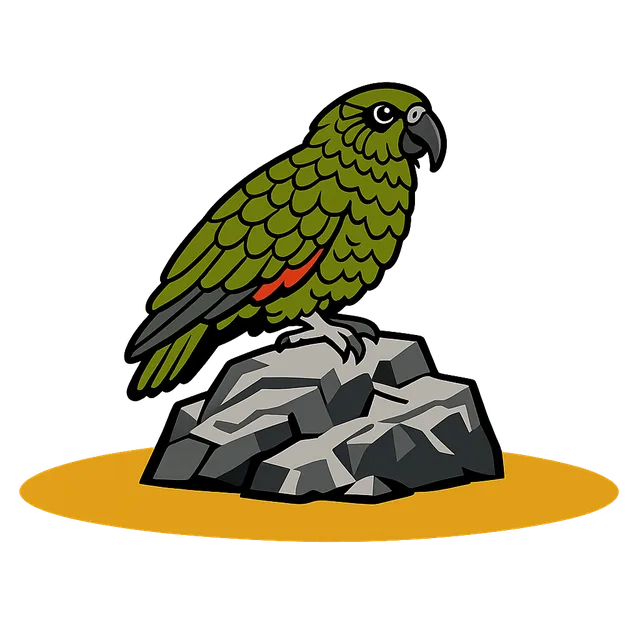
Kea are the alpine version of the same problem. They nest on the ground and spend a lot of time on it looking for food, which puts a mountain parrot at ankle height in exactly the terrain people most want to bring a dog into. That is most of why the alpine parks are the one place where the sensible answer is to leave the dog at home rather than look for a workaround. It runs both ways: kea are drawn to car parks, packs and vehicles by people feeding them, so a dog shut in a car at a high pass is not out of the picture.
The penalties are set to match. Under the Dog Control Act 1996 s 58, Under the Dog Control Act 1996 s 58, an owner whose dog attacks protected wildlife and kills it, or injures it so badly it has to be destroyed, faces up to three years imprisonment or a fine of up to $20,000, and the court must order the dog destroyed unless the circumstances were exceptional. An attack that stops short of that is still an offence under s 57. Under s 59, where a dog is at large and is an immediate threat to protected wildlife, the occupier of the land may seize or destroy it on the spot. Those numbers are steep, and proportionate to what is at stake.
The exceptions, and what they are not
There are exceptions. None of them is a route to walking a pet through a closed area.
Certified disability assist dogs. DOC's rule is that a dog certified to assist with a disability can visit any area of conservation land while it is assisting or training with someone, including places that usually do not allow dogs, national parks included. The dog needs a permit only where a person needs one to enter. This is the exception that regularly matters to a member of the public, and the flat "no exceptions" line used on a lot of New Zealand websites tells assist dog handlers the opposite of the truth.
Permits under the National Parks Act. Section 56B lets the Director-General issue a dog control permit, and s 56E allows authorisation. These exist for management and working purposes: search and rescue, pest detection, stock work, research. They are not a pet walking permit, and applying for one because you fancy the Hooker Valley with your dog is not what the section is for.
Hunting dog permits. DOC issues permits for hunting dogs on some conservation land. That is permission to hunt with a dog under conditions, not permission to take a dog for a walk, and it does not open a national park by itself. DOC asks for up to date council registration, some regions require avian awareness and avoidance training first, and permits take up to five days to process. Apply through the office that manages the land.
Conservation dogs. The detection dog and handler teams you may see working inside closed areas are certified under DOC's own programme. Working dogs on a job, not visitors.
The named places people ask about
Most of the traffic to a page like this arrives as a question about one specific track. Can I take my dog on the Tongariro Alpine Crossing, up Roys Peak, into Mautohe Cathedral Cove, along the Queen Charlotte. We have written 26 of those answers out properly, one page each, because the name is what people search and the rule is what they need.
Fair warning on the pattern: most of the answers are no, and most of the time the reason is the same two words, national park. The rest turn on tenure rather than terrain. Who manages the land, whether the track crosses a reserve class that excludes dogs, whether a council bylaw sits over the road end and the beach at the finish. That is why we do them one at a time instead of publishing a rule of thumb, and why a track can be closed to dogs while the valley next door is fine.
Where there is a legitimate alternative nearby, and there usually is, the answer page names it: the nearest walk with the same kind of view, the same sort of afternoon, and dogs actually welcome. Each row below links to the full answer, the managing authority, the evidence we based the verdict on and the date we last checked it.
Boats, beaches and the low tide line
This one gets misreported constantly, so here is the correction first: a marine reserve is not a dog ban. Marine reserves protect what sits below mean high water springs, which is the sea, and dogs are not what they regulate. Plenty of websites list marine reserves as closed to dogs. That is not where the rule lives.
The rule that does exist is about the land behind the water. You cannot take a dog ashore, or be within the foreshore of, any conservation area that does not allow dogs. DOC is specific that the foreshore includes the entire beach area down to the low tide level. So the edge of a closed reserve does not stop at the vegetation, or at the high tide mark, or where the sand starts. At low tide it reaches a long way out, and a beach that reads as open sand for a kilometre can be the front doorstep of a closed area for the whole kilometre.
The practical version, for anyone arriving by boat or kayak: work out whose land the shore is before you land, not after. If you are not certain, the dog stays aboard. That is the whole trick.
What is actually open
Now the other side of the ledger, because the closed list gets quoted so often that people turn up thinking the country is shut. It is not. We map 1,915 walks across 15 regions where dogs are welcome, 367 of them off the lead, 886 with somewhere for a swim and 773 with real shade. There are 77 DOC campsites that take dogs and 1,051 dog parks and off-leash areas, 24 of them fully fenced.
The honest framing is that the closures are concentrated rather than scattered. National parks and the strict reserve classes cover a lot of the alpine and the deep backcountry, which is where the postcards come from, so the closed list looks bigger than it walks. Regional parks, council reserves, farm parks, production forestry, rail trails, estuary boardwalks, riverbanks and most of the coast are a different story, and that is where the walking actually happens for most people most weekends. There is more open than the closed list suggests. It is just less photogenic.
Start from the map and search where you are, go by region, or check walks near you. If you want the ones where the lead comes off, that is off-lead walks, and if the dog swims, swim spots. Every verdict says which evidence lane it sits on, and the named-authority ones carry their source and the date we last checked, which is the point of how we check.